
- Itatiaia National Park
Photo: Miguel Monteiro
Itatiaia National Park
Created in 1937, Itatiaia National Park is the oldest in Brazil, and one of the most surprising. It holds a mosaic of landscapes where the Atlantic Forest meets high-altitude fields, humid valleys embrace crystalline waterfalls, and rocky peaks seem to touch the sky. Located between the states of Rio de Janeiro and Minas Gerais, the park offers a combination of adventure, contemplation, and history. Whether in the Lower Part, with accessible trails and lush vegetation, or in the Upper Part, where the highest mountains of the Serra da Mantiqueira are located, Itatiaia thrills in every detail.
Mountaineering enthusiasts will find one of the country’s most iconic landscapes, with volcanic formations that challenge the senses and reward adventurers with breathtaking views. It’s home to natural monuments such as Pico das Agulhas Negras (2,791 m high) – the fifth highest point in the country –, the Maciço das Agulhas Negras, the Maciço das Prateleiras, and Pedra do Altar. For those who prefer tranquillity, the lower part of the park is an invitation to reconnect: shaded trails, gardens, natural pools, and the enchanting Véu de Noiva waterfall make up a light itinerary ideal for families and beginners.
With excellent visitor infrastructure – including a visitor centre, camping area, mountain shelter, and even trailer accommodation – the park also stands out for its biodiversity conservation and environmental education. The region is home to dozens of species, interpretive trails, wildlife observatories, and a landscape that changes completely between seasons. More than a destination, Itatiaia National Park is a territory where nature inspires, teaches, and transforms. A place to feel the grandeur of Brazil with your feet on the trail and your heart in the heights.
When to go
The park can be visited year-round. Between April and October, the weather is usually drier, ideal for trails and hikes, especially in the Upper Part. On very cold days, the Upper Part can register sub-zero temperatures. In the summer (December to March), there is more rain, which can make access more slippery, and careful prior assessment of the weather is recommended (mountaineering and climbing are not recommended during rainy seasons).
How to get there
The park has two main access points:
- Lower Part (Visitor Centre) – Access via Itatiaia (Rio de Janeiro), from the Via Dutra (BR-116). It is about 180 Km from Rio de Janeiro.
- Upper Part (Posto Marcão) – Access via Itamonte (Minas Gerais), going up a dirt road with steep sections. 4×4 wheel drive vehicle recommended.
Opening hours
Lower Part – Tuesday to Sunday | 8 AM to 5 PM
Upper Part – Daily | From 7 AM to 6 PM (entry is usually only allowed until 2 PM to ensure return before nightfall)
Entrance fee
BRL 46.00 (full price) | BRL 23.00 (half price)
Interesting facts
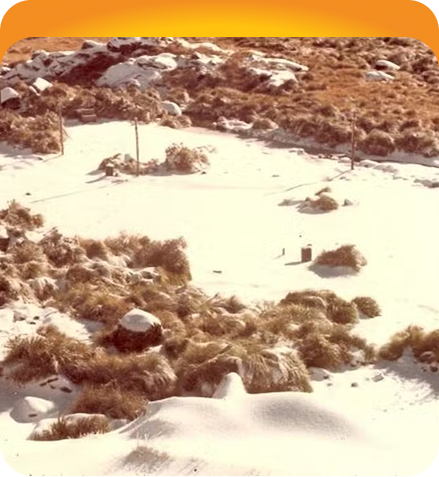
Photo de 1985 (ICMBio)
Snow in Brazil? It happens here!
In harsh winters, it can snow in the Upper Part of the park (2012 was the last time). A rare but real phenomenon! This is because it is in one of the highest regions of southeastern Brazil. Frosts and sub-zero temperatures are common between June and August (-9.4° C in June 2025).
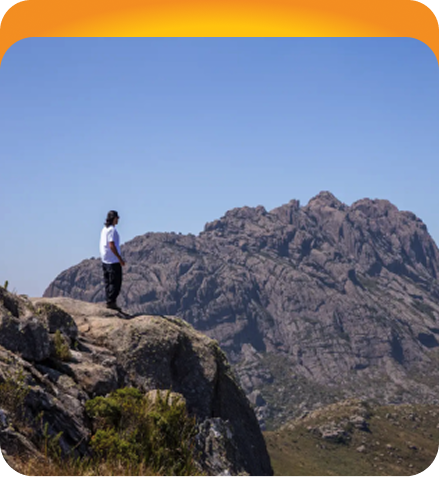
Vegetation that varies with altitude
The diversity of altitudes creates a mosaic of landscapes throughout the park. In the Lower Part, the humid Atlantic Forest dominates the scenery. In the Upper Part, high-altitude fields emerge, low-lying vegetation adapted to the intense cold and gusts of wind, typical of the mountains.
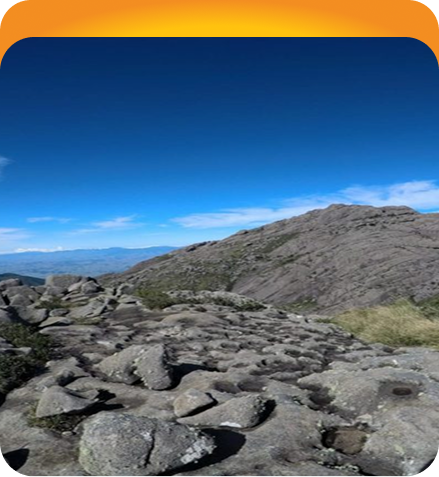
Cinematic sky in the Upper Part
The Upper Part of the park, being far from urban centres and at a high altitude, is ideal for Astro tourism. On clear nights, the sky is a spectacle, with stars visible to the naked eye and little light pollution. Some visitors report seeing the Milky Way with stunning clarity.
Agulhas Negras Massif
This is the highest point in the park and is located in the Upper Part. The trail to the base of the peak is considered moderate and is 1.5 Km long (starting from the Rebouças Shelter). Hiring a guide specialized in mountaineering and climbing is recommended.
Prateleiras Massif
Formed by imposing rock blocks, its summit is over 2,500 m high with a breathtaking view of the Paraíba Valley. In its surroundings, it is also possible to find the Apple Rock, the Turtle Rock, and the Seated Rock. The trail to the base is 2.5 Km long (starting from the Rebouças Shelter) and has a moderate level of difficulty. It is recommended to hire a guide specialized in mountaineering and climbing.
Three Peaks Trail
Located in the Lower Part, the trail is steep and requires a full day of hiking. It is 8 Km from the Visitor Centre. To do this route, it is mandatory to fill out the Liability Waiver, available in the Park. It is recommended to hire a guide specialized in mountaineering and climbing.
Altar Rock
The 11th highest point in Brazil has an altitude of 2,665 m and offers a 360º view of the park. The trail is considered moderate, with a length of 3 Km (from the Rebouças Shelter). It is recommended to hire a guide specialized in mountaineering and climbing.
Couto Hill
With a length of 3 Km (from the Marcão Post), the trail is considered moderate and provides an exclusive view of the Serra da Mantiqueira and the Paraíba Valley. It is recommended to hire a guide specialized in mountaineering and climbing.
Five Lakes Circuit
A total route of 12 Km that includes the lakes and also the Cinco Lagos Waterfall, which is formed by the outflow of one of the lakes. The trail also passes by Pedra do Altar (Altar Rock). Hiring a specialized mountaineering guide is recommended.
Blue Lake
A natural pool on the Campo Belo River, located in the Lower Part of the park.
Poranga Waterfall
A pool of green water formed by a 10-meter drop, quite voluminous and enchanting.
Maromba Complex
The complex consists of three main attractions: the Maromba Natural Pool, the Itaporani Waterfall, and the stunning Bridal Veil Waterfall.
Mirror of the Sky Pool
A beautiful, calm natural pool, ideal for enjoying the day with the family.
Itupi Waterfall
Walking along a 1.4 Km trail (starting from the Visitor Centre), you will find an exuberant landscape formed by the waters of the Campo Belo River.


Embratur and Visit Brasil are not responsible in cases of poor performance or not providing the experience conveyed. Service providers are solely responsible for the activities sold.
Soon, more natural parks itineraries will be launched.
©2025. Embratur & Visit Brasil | All rights reserved.